• About

LIVEdigitally

Category Archives: Convergence

Does TiVo make Products or Patents?

Posted on March 9, 2010 by Jeremy Toeman

For all intents and purposes, TiVo “invented” the DVR. Actually, they didn’t, but it’s a fair statement that they first successfully commercialized it and brought the concept to the massess.  Further, they did it with competition (ReplayTV), which is often the exact thing that stalls new consumer technology adoption.  The company’s product was loved by those who used it (I had the original 14-hour Philips version), and switching from TiVo to another DVR was a painful process for those of us who had to go through it (for whatever reason).  But switch we did, as the company slowly got pushed out of dominance by failing to keep a healthy relationship with DirecTV (and Philips, Sharp, and others), and all other cable/sat co’s offered their own (mediocre at best) versions of the DVR.  And when a consumer is given the choice of an effectively “free” DVR (an additional $5/mo = free in a purchase decision-making process when already spending $50-$100 on a bill) versus buying one with an upfront fee and a monthly tally, it’s a no brainer.

Over the past few years, the company has slowly settled from being the leader in both installed base and most evolved product into a bit of obscurity with the mainstream (other than potentially owning the brand-category, which doesn’t do much good for running a business).  Their Series 3 and other launches in the late ’00s didn’t bring in a new rush of users, and last week’s launch of the Series 4 (aka TiVo Premiere) is at best a late entry in a crowded market, and at worst a product that massively missed the mark with modern day expectations. On the date of the launch, the company’s stock moved a little bit upwards.  Not too shabby, but also not too interesting.
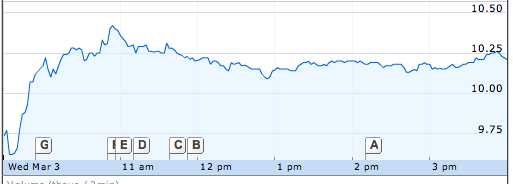
The next day, however, proved much more interesting, with a 61% increase in value:
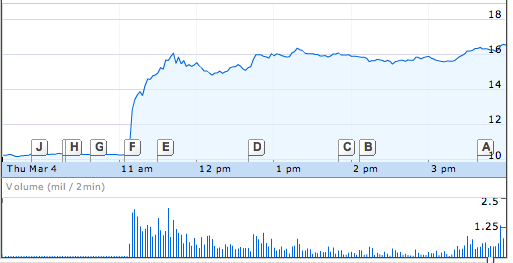
What happened? In a nutshell, federal courts found TiVo’s patents held up against a Echostar/DISH claim.

I’m not a lawyer, nor do I generally support the present-day patent system, but that’s not really the point here. What is more relevant is that TiVo appears to have drifted from being a pioneer in the digital home to being a patent player. Instead of betting on the strength of their product team, innovation, and marketing, they are now betting on their lawyers.  And I think that’s a sad state of affairs.

The digital home is a noisy, confusing place, fraught with terrible products. Further, most of the products I’ve seen on the radar or know are shipping soon are also now extremely impressive.  In other words, there’s tons of opportunity today and in the future to build (and monetize) exciting products.

I’d love to see TiVo make a change in direction here.  It’s time for the company to act like a startup again, and show real innovation like they once did.  Truth be told I know the TiVo Premiere is unquestionably a better product than my Comcast DVR (a truly awful product).  But as has been said many times before, and is unbelievably relevant in the convergence space, Good Enough is the biggest enemy of Great products. It’s going to take a heck of a lot more than “slightly better than the last version” for TiVo to regain a leadership position.  The company needs to rebuild it’s team with new innovators who can build on the legacy, and stop investing in “me-too” minor touches, “dongles”, and other things that won’t move the needles. CableCard? Still? Come on.

If companies like Apple, Palm, and so many others can attempt to reinvent themselves, I think TiVo can too.  Please try.

Posted in Convergence, Video/Music/Media | Tags: comcast, dvr, patent, tivo | 3 Comments |

What Did Jobs Do?

Posted on January 27, 2010 by Jeremy Toeman

In proper form,I shall now review my own predictions of the iPad from my first two posts on the subject (parts 1 and 2).  Let’s start with…

What I got wrong:

Productivity Apps
I said: “Unlike the Microsoft approach to “ecosystem” – where everything other than the Xbox is able to view and edit Excel spreadsheets – my hunch is the iPad is all about lifestyle, the Internet, and entertainment.  I’d guess there’s a native version of Safari, some kind of simple email and calendaring, and that’s about it.”

In reality: native new version of iWork!

Reaction: I’m pretty surprised by this move. I certainly see the case for casual work-like content creation (make a simple budget, add some numbers, etc), but figured this would be much more of an afterthought. Further, without an input mechanism (camera – more below) beyond the touchscreen, I don’t quite feel the product “fits” as a content creator.

Augmented Reality/Content Creation
I said: “I’d predict there are several native applications and services that provide very cool augmented reality features.  I’m firmly in the camp of one or more cameras on the iPad, and I think Apple will include one or more fun exploits of the concept from the get-go.”

In reality: zero cameras.

Reaction: This is unquestionably the most questionable aspect of the iPad (like how I did that?). There’s one in the Nano, but not here? Just doesn’t make sense to me, nor most of the people I spoke with during and post the event.  My colleague Jim Schaff thinks this is effectively a beancounter’s decision – the numbers were run that showed adding a camera could/would cannibalize from either MacBook or iPhone sales, and thus the camera was dropped.  Other folks I’ve spoken with theorize it’ll show up in a rapid revision of the product (something I don’t agree with, as they had no specific reason to rush the iPad to market, and could easily have waited until it was working).  My other theory here is that it’s not a hardware issue, but a product/software complexity issue, and the overall impact of adding a camera would have created too significant a product development challenge in the short term.  Gotta crawl before ya run.

Hardware ins/outs
I said: “It’ll have the iPod connector, USB, DisplayPort and an SD card slot.  A webcam is highly probably, and I wouldn’t be surprised with an IR interface as well.”

In reality: custom dock connector, USB, no other ports.

Reaction: I’m disappointed at the lack of SD card reader, especially in context of the photo frame use-case.

What I got right:

The name
I said: “iPad”.  😉

Heavy software emphasis
I said: “Everything that ships on the iPad will be designed completely to work in a touch fashion, or it won’t be included period.  I’m still torn between whether it’ll be a version of OS X or a version of the iPhone OS, but either way, the device will ship with oodles of applicable software, custom-built to be great in gesture, touch, multi-touch, or even by looking at it the right way.”

Closed app infrastructure
I said: “I expect the iPad will sit somewhere between the iPhone, with individually manually approved apps, and the OS X platform.  Based on the reports today that some apps are supposedly already being run on the iPad (of course these reports prove absolutely nothing, as it could either be an updated iPhone with a new OS, or simply another “labs” product running around campus.  but where would modern tech blogging be without unsubstantiated rumor circulation and amplification?) , my leaning is a differentiated version of the iPhone OS, with more leniency in app approval, but still not open. Many will complain, many will profit, and many will love it.”

Single carrier support
I said: “And since the former isn’t very Apple-y, it’s much more likely there’s only one carrier involved” and “It’ll have 3G services built-in.  I’d hope for Verizon, but that limits Apple to its international possibilities.  And there’s no way they’d waste the money on two different 3G chips.”

Note that I’m surprised, but not shocked, that it’s still just AT&T.

Media Slate as product definition
I said: “So picture a device that’s sleek and sexy, can play back movies, TV shows (including live TV), Internet radio (lala), show pictures/slideshows, play simple games (app store), and be otherwise completely entertaining.  It connects from anywhere, has enough internal storage to last a nationwide flight, and is all about fun.  Further, it comes with numerous context access options, including free services, a la carte purchasing/rentals, and subscription options.  It probably also has a Webcam and native iChat support. I’m fairly bullish on this concept, as it seems to fit in with the Apple iLifestyle very well, and makes for a useful product.”

Parting thoughts:

I’m actually going to write another blog post with my specific thoughts on the iPad (and I’m the only guy doing that!).  My quickest reactions are that I’m impressed with the price point, but shocked about the lack of camera.  I think they *will* sell millions of units, and it’ll be more compelling to a more mainstream audience than many others think, though I still find flaws in the overall offering.  In reality, this device is actually a very good alternate “home computer” for the average person who only needs web surfing, email, media playback, and entertainment. It’s certainly more compelling than a Netbook.

For some final fun, here’s the blog post I wrote predicting roughly this device. Of course that was back in July 2007.

Posted in Convergence, Gadgets, Mobile Technology | Tags: Apple, ipad, predictions, tablet | 6 Comments |

What Wouldn't Jobs Do?

Posted on January 24, 2010 by Jeremy Toeman

The other day I surmised on what the iPad (still calling it that – it’s the shortest option) might be, as a device.  With only three days left to go prior to launch, I still find myself pondering the “how do they build something at the right price point that’s useful beyond the context of novelty and/or on the commode?” question. While many are going gaga over pretty much anything that could come out, I in my stubborn fashion still just can’t conceptualize what we are about to see.  Of course I’m effectively ready to pre-order it, but I still can’t piece it all together in my head.  So as the follow-up to what might the product be, I thought I’d amble on about what I don’t think we’ll see…

Hardware without software
One of my general rants about Tablet PCs is the lack of compelling software.  Sure Microsoft splashed some “touch features” across the OS, but for the most part it’s a trainwreck.  Apple won’t do this. Everything that ships on the iPad will be designed completely to work in a touch fashion, or it won’t be included period.  I’m still torn between whether it’ll be a version of OS X or a version of the iPhone OS, but either way, the device will ship with oodles of applicable software, custom-built to be great in gesture, touch, multi-touch, or even by looking at it the right way.

Niche or otherwise narrow market scoped
I stated in my last post that a possible product category is just a heads-on Kindle killer.  I’d characterize this as a small opportunity – yes, it’s been great for Amazon, but the market for “better than Kindle e-readers” is small. The only small product Apple still ships is the Apple TV, which they’ve characterized as a hobby product (and rightfully so) from day one.  Granted they haven’t actually said anything about the iPad yet, but their PR machine is too smart to let this much buzz build up and fall that short.  Then again, if this thing doesn’t come with an espresso maker and difribulator, some people are going to be disappointed.

An open platform

Even though the modern day Mac world is based on Unix and has a wide developer base with tons of open source projects, it’s pretty safe to call Apple a company that chooses the proprietary path more often than not.  And while this might frustrate many, the benefits of typically stable products are certainly appealing to the masses.  I expect the iPad will sit somewhere between the iPhone, with individually manually approved apps, and the OS X platform.  Based on the reports today that some apps are supposedly already being run on the iPad (of course these reports prove absolutely nothing, as it could either be an updated iPhone with a new OS, or simply another “labs” product running around campus.  but where would modern tech blogging be without unsubstantiated rumor circulation and amplification?) , my leaning is a differentiated version of the iPhone OS, with more leniency in app approval, but still not open. Many will complain, many will profit, and many will love it.

Focused on productivity
Unlike the Microsoft approach to “ecosystem” – where everything other than the Xbox is able to view and edit Excel spreadsheets – my hunch is the iPad is all about lifestyle, the Internet, and entertainment.  I’d guess there’s a native version of Safari, some kind of simple email and calendaring, and that’s about it.  I think Apple doesn’t have any interest in trying to build buzz or sales into the corporate world, and will instead stay close to their home turf with consumer appeal.  I’d go so far as to say it’ll be fun to use, and the new user experience will center entirely around delivering entertaining content.

Support every mobile carrier
Okay, this is one of those “I think I’m right, but what if they really figured it out???” things (Google didn’t really, and they’ve got some smarty folks too).  Supporting all the US carriers is cost prohibitively “impossible” – you’d need a minimum of 2 different antennas/chips and the relationships in place.  Doing this adds to cost, which is transferred somewhere (consumers), and for the most part neither manufacturers nor consumers like to have “wasteful” componentry.  Which means it’s much more likely there’s either multiple SKUs, or only one carrier.  And since the former isn’t very Apple-y, it’s much more likely there’s only one carrier involved – or none at all (which makes some sense, if this were 1997).  Further, this gets messy when we consider Verizon, the best network in the US, as their CDMA platform is unused in Europe, a place where Apple sells a lot of stuff.

I could probably add a few more pages of the what I don’t think will happen variety, but they start getting less interesting in my own opinion (5 colors of iPads! – not).  I did have one more “I’ll bet they do” item, which is…

Embrace Augmented Reality Even More
Lots of hot trends in the technosphere, from Twitter to FourSquare, from App Stores to Cloud Computing.  But Augmented Reality is actually an interesting one, has more usefulness than others, and is right up Apple’s alley.  I’d predict there are several native applications and services that provide very cool augmented reality features.  I’m firmly in the camp of one or more cameras on the iPad, and I think Apple will include one or more fun exploits of the concept from the get-go.  I don’t know if it’ll be as awe-inspiring as PlayGunman, our amazing lasertag on iPhone game, but hopefully it’ll be close (disclosure – I’m extremely involved in it. also, I’m joking around – if Apple can’t make our game look like Adventure on the 2600, I’d be stunned. and it’s not like our guys are slackers, but it’s freaking Apple).  Apple will definitely do some kind of boundary-pushing move with this device, and I’d hunch that augmented reality is one of the areas they could truly make us think a little differently.


Posted in Convergence, Gadgets, Mobile Technology | Tags: Apple, apple tablet, augmented reality, ipad, iphone, mobile, tablet | 2 Comments |

15 vs 50: The Battle of the Future of Television

Posted on January 18, 2010 by Jeremy Toeman

When you look at the stats for video consumed on computer screens, it’s fairly staggering.  Literally hundreds of millions of videos per day on YouTube alone, 26 billion videos online in the month of September, averaging about 10 hours per month per person.  From one perspective, this could be considered inconsequential relative to the estimated 8 hours per day on the old fashioned TV set (though that stat is open to some interpretation).  However, considering this is still the early days of quality content being available online, it’s pretty safe to say that the computer (and of course Internet) is a successful media playback device.  So is the future of entertainment going to live on the 50″ HDTV display or the 15″ laptop?

The old argument: the PC is a terrible entertainment platform
At my job a decade ago I used to travel around the world meeting with virtually every company who built PCs, phones, and other gadgets.  At the time the focus was on the emerging “digital home”, a wonderful place where we envisioned the PC (for sake of typing, when I say “PC” I mean “computer” and include Macs in this generalization) as the “server” device, providing media to enjoy on connected TVs and stereos. We used to talk about how terrible a laptop or desktop was as a media consumption device, and how nobody would really want to sit around a small screen to watch any kind of premium content.  Other than the time I thought Amazon wouldn’t get anywhere selling books online, I can’t think of a time I was more wrong about something.  In reality PCs are now phenomenal media devices.  Laptops are unbelievably convenient when it comes to portable entertainment, and you can readily purchase surround sound setups for desktops.

All the ways the PC rules
The computer is unquestionably the most versatile product since the invention of the wheel, and when it comes to entertainment offerings, there’s no shortage of tools and services to enhance one’s experience.  With a computer and a high-speed Internet connection, we are a hair’s width away from a true all-content on-demand any-time lifestyle (and for those willing to skirt some pesky laws, they are already living that way).  Whether it’s Pandora or last.fm, Hulu or Windows Media Center (or even the remote possibility that TV Everywhere actually delivers as promised), you can have truly personalized media experience, all the time.

The kids today…
As a youth I distinctly remember our home’s expansion to a few dozen channels and our fancy remote control (which was actually wired to the cable box).  By the time I was in college, we had a couple of hundred channels, pay-per-view content, and premium cable offerings.  The living room was the only real place in the home for entertainment, with our CRT TV, video game console, cable box, and VCR.  College-age kids today have a very different perspective.  Paying for content (other than video games) is a generally foreign concept, as they’ve been surrounded by free for a long, long time.  And this is nothing compared with young children who are growing up in the post-DVR, on-demand world, where programming schedules seem utterly arbitrary.  People under 25 (and some above, of course) are used to taking their entertainment with them, and the only reason to bother going into the living room is to use their game console for gaming, chatting with friends, or watching movies – all activities they’d prefer to do in their own space anyway.

So is my $4000 (2000 1000 500!) high definition set with surround sound a dinosaur?
Ask me that after I watch Dark Knight in 1080p for the 3rd time. Or during the Stanley Cup Finals. Or even for an episode of Glee (yeah, I watch it, but I offset it with Man vs Wild, so back off). There’s just some content that, if given the option, I’d rather watch on a humongo-screen with amazing sound.  And no matter how much time we spend watching content on our laptops or phones, it’s just a different type of experience.  Further, the TV industry isn’t about to go quietly into any goodnight – innovation in televisions is probably moving faster than we’ve seen in the past 3 decades.  Today you can already buy TVs with built-in Internet streaming from a variety of sources, and we’re seeing numerous experiments with 2-way interactivity and 3d displays.  So the era of “making em bigger and cheaper” seems to be fading into the era of “making em do more”.

Some infallible predictions:

  • The popular categories of TV sizes will remain the same for the foreseeable future
  • PC/online media consumption rates will increase (rapidly) over the next 5 years
  • TV viewing rates will NOT decrease over the next 5 years
  • Cable attachment rates (# of people who pay a cable/satellite company) will decrease over the next 5 years, specifically due to people “cutting the cord” and consuming Internet-provided content instead
  • All major sports will have full live and archived streams available online within 2 years
  • At least one major sport will provide direct-to-TV streaming services within 2 years
  • Blu-Ray will continue to flounder, but will show continued (mild) growth for the next few years
  • Real-time interactivity will be tested on major TV shows in the next 2 years (and it’ll be more than just a twitter stream!)
  • Apple will do something more interesting in this space than Apple TV.
  • 3D will not drive the sales of new sets anywhere near what “the industry” hope or project
  • The biggest growth area will be the confluence of laptop use simultaneous to TV viewing
  • There will likely be a resurgence in more dedicated portable media players (that aren’t iPhones) with native streaming services.  They will fare poorly.
  • The concept of the “convergence/Internet set-top box” as well.  These too will do poorly.
  • In 3 years there will be 14 different versions of CSI on the air. Also, the writers of Heroes will still fail in their attempt to kill a character permanently.

I’m loving it
Let’s face it, this is an exciting time for being entertained.  There are so many ways to consume content, and so many interesting experiments occurring around the industry.  Further, many “standards” are pretty well in place, meaning the 720p 42″ plasma you bought 3 years ago is still going to work just fine 3 years from now.  This is unquestionably a good time for innovators, entrepreneurs, and consumers alike.  If you find yourself bored and you have a screen somewhere nearby, you just aren’t trying hard enough.

Disclosures: I was on the steering committee for UPnP, DLNA, I built the Slingbox, and have consulted on topics related to convergence and marketing/PR for Boxee, DivX, VUDU, Clicker.com, NETGEAR. As such, I’ve attempted to avoid anything specific to those companies in this post. In no way are any of my consulting clients related to my tech blogging, though one could argue I’ve seemed to align myself with companies who build cool stuff in the convergence space – and they would be right.

Posted in Convergence | Tags: Convergence, future, internet, laptop, streaming, television, TV, video on demand, youtube | 1 Comment |

Social Media meets Consumer Electronics at CES2009

Posted on December 9, 2008 by Jeremy Toeman

I try to keep the “plug Jeremy” posts to a minimum, but it’s my blog, and I can do what I want, right?

I’ve been invited to participate in Jeff Pulver’s exciting new event at CES 2009, called “Social Media Jungle.”  During the daylong session, a variety of very accomplished speakers will present on a variety of topics pertaining to social media and trends for 2009. In my case I’ll try to “bridge the gap” to address the CE industry.

Jeff’s description of the event:

“The Social Media Jungle at the 2009 International CES brings to light how the advent of social media is changing the way we work and live. Sessions include state-of-the-industry updates and a candid look at how social media disrupts the workplace by empowering companies to lower burn rates. Plus, learn how companies can motivate consumers through social media to drive product sales without increasing costs.”

Here’s the agenda:

8:30 – 9:00: Real-Time Social Networking
9:00 – 9:20: Welcome to the Jungle, Jeff Pulver
9:20 – 9:40: Navigating the Social Media Seas, Chris Brogan
9:40 – 10:00 – Industry Perspective & Update
10:00 – 10:20 – Industry Perspective & Update
10:20 – 10:40 – What to Look for in Social Media Platforms in 2009, Robert Scoble
10:40 – 11:00 – Return on Social Media Investment, Ben Grossman
11:00 – 11:20 – [ break ]
11:20 – 11:40 – Learn, Baby, Learn: Turn Your Social Media Addiction Into An Asset!, Jeffrey Sass
11:40 – 12:00 – Social Media Principles, Chris Heuer
12:00 – 12:20 – Naked PR: What Marketers Need to Know in the Age of Social Media, Susan Etlinger
12:30 – 2:00 [Lunch Break]
2:00 – 2:30 – How Reporters Have to Think of Themselves as an Entrepreneur and a Publisher Using their Company as a Platform, Daniel Honigman
2:30 – 2:50 – New Media Strategy in Challenging Times: Conquering the 3 Screen World: Dean Landsman and Howard Greenstein
2:50 – 3:10 – How Small Business can use Inbound Marketing/Social Media to Help Increase Their Business, Justin Levy
3:10 – 3:30 – The Convergence of CE and Social Media, Jeremy Toeman
3:30 – 3:50 – Managing Your Reputation While Being Genuine and Authentic Online, Dave Taylor
3:50 – 4:10 – How to Botch an Agency Briefing (No Matter How Cool You Think Your Product Is), David Berkowitz
4:10 – 4:20 [break]
4:20 – 4:40 – How Trust Drives Transactions During a Down Economy, Eric Weaver
4:40 – 5:00 – Leveraging Social Media for the Social Good, Rebecca Bollwitt
5:00 – 5:20 – How New Media is Changing the World, Brian Reich
5:20 – 5:40 – Transforming Unemployed BabyBoomers via Social Media, Carlos Hernandez
5:40 – 5:45 – Wrap up

I’ll be talking about how “social media” is infiltrating consumer electronics devices.  There are already a handful of products on the market or coming to the market with built-in social services.  The future of devices is clearly all around connectivity, and the interesting phase will be understanding how we get from today (mostly disconnected islands of functionality) to tomorrow (intelligent data sharing between devices and Internet services).

Registration costs: US$ 295 / 395 (Social Media Jungle page on the CES website and Facebook page).

Posted in Convergence, Gadgets, Web/Internet | Tags: ces, ces2009, social media | Leave a comment |

Sonos + Pandora = 42

Posted on October 28, 2008 by Jeremy Toeman

My insufficiently geeky readers probably won’t get the 42 reference, so I’ll assume you read this reference before continuing. Of all the convergence I’ve seen that bridge gadgets with Web services, I think the implementation of Pandora’s free Internet radio service onto the Sonos music system is probably the best.   The single “snag” in the entire system is that you actually need to (1) have a Pandora account, and (2) own a Sonos.  If you don’t, I recommend correcting the situation immediately.

In a nutshell, Pandora works by building “radio stations” based on artists and/or tracks you like.  If you pick Frank Sinatra, boom, you have a Frank Sinatra Radio Station.  Add other artists, and create your Smooth Crooners Radio Station.  If you don’t get it yet, well, go to Pandora and set up an account, it is free after all.  The super delicious part of the story is how well they integrated with Sonos.

On your Sonos, you simply need to add your Pandora username/password, then you have access to virtually all Pandora features.  Key to it is how easy it is to use on the Sonos, including bookmarking content and creating new stations.  One of the softkey (programmable) buttons is labeled “ratings”, the other “Pandora”.

Click “ratings” to rapidly Like, Dislike, or Not hear a song for a month.  Perfectly logical, works just like Pandora on the Web does.  This feature is one of the key parts to how Pandora works – while you can’t specifically pick songs to play, the collaborative filtering system (recommendations) works extremely well.

The “pandora” button allows you to add the given song or artist to your current radio station, or build a new station based on the song/artist.  Again, this implementation is exactly how it should work.  Within minutes I created five different stations, all in different genres, with practically no effort.  You can similarly bookmark content to retrieve later at pandora.com.

I’ve ripped my 800+ CD collection into MP3.  We have access to tons of other streaming Internet content.  I can say without hesitation that 90% of my Sonos listening will now be over Pandora (and my new house has 7 Sonos zones planned).  Amazing job to both companies.  BTW, Sonos also introduced an iPhone app, but since I’m not an iPhone guy I’ll let the pro’s talk about how great that is instead…

Posted in Convergence, LD Approved, Video/Music/Media | Tags: music, pandora, radio, sonos | Leave a comment |

Wireless HDTV R&D Update: Tons of Spending, Tiny Market

Posted on July 23, 2008 by Jeremy Toeman

Saw a thread on Techmeme this morning about wireless HDTV technology. Looks like some big companies are banding together to provide (yet another) wireless HDTV service. Over at Crave I read that while it’s a year away (read: 2-5 years away), it’ll be fairly low-cost, as in ~$100 (read: ~$500) per set to enable the technology. There’s also multiple competing standards, and as MG points out, two of the companies involved are participating in both platforms (updated: now both PCMag and Ars weigh in as well). This is a lot of big companies spending big budgets to build multiple technologies and standards in the space.

I ask “why?”.

Seriously. What’s the point here? So people can one day wirelessly stream video from a hard drive/PC in one room of their house to the plasma display in another room? Really? Don’t get me wrong, it sure sounds like a fun idea, and there’ll be some percent of the market willing to do it, but most definitely not the majority.

The other argument for it is just to have a short range, enabling me to “cut the cables” from my plasma to my HD set top box. Only one catch here: very few people will be willing to upgrade both their boxes and sets just to hide one cable, especially considering they still need the power cord! While the WAF is certainly a powerful force in every home, I don’t think anyone can argue that a plasma should be replaced to reduce a single cable.

I’m sure I’m missing some points here, but having spent the better part of 8 years working with organizations like UPnP and DLNA, it seems like neither the “connected home” nor “interoperability” are initiatives which win (ask Apple how interoperable the iPod is). There’s a lot of money being spent on R&D labs for this type of technology. Whenever it gets out of the labs it will need to go into *massive* testing before any cable company even considers distributing a box with new technology (ever wonder why it took Comcast 3 years to ship a DVR? it wasn’t a lack of technology, it was testing, and even then they still did a mediocre job with it). As a final point on the market opportunity here, just remember how well this must be testing in focus groups…

Would you like it if your plasma display worked wirelessly (not including power), and only cost $100 more?

Golly, sure I would!

Would you be willing to replace your cable box if you could get one that didn’t need any wires to hook up to your plasma?

Gee whiz, absolutely!

Anyone notice that the #1 seller of plasma TVs is not a participant here? Considering how well Vizio’s taken over the market, it seems pretty clear that customers are trying to save $100 by purchasing a brand they’ve never heard of before. But $100 for wifi HDTV streaming to/from nebulous devices with multiple standards? Yeah, that’ll happen.

Posted in Convergence, Networking, Video/Music/Media | Tags: HDTV, wifi | 2 Comments |

Thoughts on the Netflix box

Posted on May 20, 2008 by Jeremy Toeman

Bringing you up to speed: Netflix announced a $99 device that hooks up to your TV and streams movies (free to Netflix subscribers) from your queue straight to your set. This is not the first “Internet set-top box” to come out, nor will it be the last. But it’s definitely one of the more interesting ones to discuss. Here are my thoughts on it, in a semi-organized manner:

What I like about it:

  • Price point: under $100 is great (under $50 is perfection), especially in conjunction with free movies.
  • Netflix brand extension: the company’s followers tend to be fairly loyal (I’ve heard an estimated 5-10% churn before, which isn’t too bad considering the space they are in), and have the financial resources to make a $100 box a near-no-brainer purchase.
  • K.I.S.S.: the pictured remote only has a few buttons, and they aren’t making an “all in one killer box” (which would be much harder to market than a specific, focused product)
  • HDMI: absolutely essential.

What I don’t like about it:

  • Price point: seems like they could’ve found a way to make it free with a committed subscription. I personally pay $17.95/mo for my Netflix subscription, I have to think there’s a point ($25.95?) where I’d upgrade my service for the box. This is how the cable companies “get ya” and I think should be considered by the company.
  • Roku’s brand: it’s effectively nonexistent with the masses, which is who this product is targeting. I don’t feel Netflix gains much (other than possibly having complete control over the product, a la Apple)
  • It’s a box: like Thomas Hawk said, people don’t want more boxes in their living rooms.
  • Competing with cable companies: Comcast offers me dozens of free HD movies per month (hundreds of SD ones), and lots of PPV content to boot. I’m concerned that for $100 I don’t really feel I get much extra, and as I state above, I now have to deal with an extra box in the mix.

Other misc thoughts:

  • Initial reviews seem positive, I’m hoping to try it myself soon. I think for the box to succeed it has to be better than “easy to use”, it has to be “compelling to use”. A slam dunk would be my wife not just using it, but loving it enough to tell her friends (which was not true of VuDu, and only partially true of Moviebeam). The process of selecting movies to watch and the actual playback have to work great (think TiVo). Ditto for setup.
  • According to CNET, HD content is coming soon, and I think this is a questionable move. I believe launching with HD would make a huge difference in the marketability of the box. Also, it seems that it doesn’t offer upscaling on the SD video, which means I’ll be watching content that looks less good than a standard DVD.
  • I wish they had taken a page from the Apple playbook and made a more interesting/attractive product. Either that or follow the Slingbox “purple cow” approach. I totally understand the reasons for the generic gray consumer electronics product, but I feel it’s a tactical error in this case. Netflix has always stood out from the crowd, and I think their box should do the same.
  • Their biggest competitive threats are, in order: nothing, a digital cable box, a DVR, a computer (media center or not), an Xbox 360, and maybe an Apple TV. I don’t really see anything else currently on the market as actually competitive.

Back in January I voiced my concerns over this exact product. I like where they’ve gotten so far, but still have a lot of concerns over market viability. I believe with some polish and evolution, combined with paying a lot of attention to early adopters’ feedback (different from beta testers!), and great marketing, they might be able to turn this into a big hit. I’ll definitely be watching!

Posted in Convergence, Product Announcements, Video/Music/Media | 5 Comments |

Is Sezmi a "cable killer"?

Posted on May 1, 2008 by Jeremy Toeman

As I write this, Comcast is worth 67 billion dollars.  Their stock has split 4 times in 20 years, and has grown massively over that time.  They have over 24 million subscribers.  They are one of several US cable companies, who take on the 2 satellite service providers as the main players in the TV space for the US.  And startup Sezmi was labeled today as a cable killer, with TV 2.0, whose advanced set-top box apparently blows away the TV.  Wow.  That’s quite a strong billing, don’t you think. The last device I recall with this type of hype was supposed to transform the way we build cities.

This isn’t just David vs Goliath by the way, this is David the little tiny ant versus Goliath the elephant.  Not only does Sezmi have to compete against huge players, they are doing it in a massively entrenched industry that spends ridiculous amounts of money advertising their own services.  And let’s think about that advertising for a second – where exactly is Sezmi going to run their ads?  Are they going to pay the very networks they need to compete with?

Now I do need to make a very clear disclaimer here: I have not used their product, nor even seen a demo.  I will go on the leap of faith that they have built the very best darn box ever built (even better than the ones I’ve built!).  I’m going to assume it’s utterly amazing, and the content quality is stellar, it’s really usable, etc.  I’ve only seen one such demo in recent months, but that’s another story for another time.  Let’s assume that in the world of “terrible Internet set-top boxes” they’ve built the iPhone of the batch.   I still think they have a huge challenge ahead.

First, they need to market the heck out of this thing.  I’ve watched MovieBeam try and fail, ReplayTV is gone, Akimbo is a service now, and even everybody’s favorite TiVo isn’t exactly a commonly owned product (somewhere around 5ish million homes is the latest I’ve heard).  Each of these companies have spent millions of dollars trying.  And I can name a dozen others who’ve tried.  Even Apple can’t really move the AppleTV in massive quantities.  And massive quantities is the only way to be successful as a startup in this space.

Beyond just “extremely good” marketing,  it’s a big uphill battle for Sezmi.  Both PaidContent and Engadget refer to the company as confusing.  In the articles I’ve read the company’s advantages seem to lie in (1) price, and (2) Internet services.  I don’t believe these to be true competitive differentiators in the “taking on the cable industry” space.  The players that be have effectively infinite dollars to throw at the problem, and we know they are all working on introducing Internet-enabled devices themselves.

Having spent most of the past 10 years of my career attempting to introduce products just like these, with variations here and there, I do wish the founders the best of luck with the effort.  I would love to try the box out, see if it’s exceeding expectations and get a sense of how they plan to accomplish their arduous task.  I think the visions of wanting to “change television” are noble, but unrealistics.  Just because we have deregulation and things like OpenCable doesn’t mean the window of opportunity is open.

I do believe we’ll see additional interesting new media concepts for digital devices and platforms, but I don’t believe going after the big guys is the way to be successful.   It isn’t about a “better than your cablebox” or a “more channels than you have now” or even a “get the Internets on the teevees” kind of play.  It’s about counterprogramming against the TV itself.  It’s about innovating on other, existing platforms.  It’s about moving around the concept of the cablebox and cable company completely.  Is Sezmi here with that new Innovator’s solution?  We’ll find out soon enough.

Posted in Convergence, Product Announcements, Video/Music/Media, Web/Internet | Leave a comment |

The LG/Netflix box might just succeed

Posted on January 3, 2008 by Jeremy Toeman

There’s only room for 4 devices in the average living room. They are: a display (LCD/plasma/whatever), a cable/satellite receiver (aka set top box or STB), a DVD player, and a game console. For travelers, you can add a Slingbox to that list, but that’s about where I draw the line (sounds like Erick at TechCrunch has a similar philosophy). Remember, I said “average” living room. I’ll expand on my four device theory at a later date.

Netflix was rumored to be building its own box, a project I was sure to see fail. Instead (or in addition or in replacement of) they are going to integrate their Internet delivery service into some future LG products. This is, in my opinion, the only path for success. By doing so they eliminate all risk of becoming a hardware company, which surely would have sent them on the path to failure.

Don Frommer at SAI asks 5 good questions, but of them I feel only one is extremely relevant: how much will they cost? On the PC you get one movie per dollar you spend per month with Netflix. If that model translates to the TV box, then we have a winner. If, on the other hand, I have to spend per movie, then Houston, we have a problem. That would put them squarely into competing with cable/satellite on-demand services, and Comcast has a much bigger war chest in that arena.

Over at NewTeeVee the question of competitive services is raised, citing AppleTV, VUDU, Amazon Unbox/TiVo as comparison products. In my eyes, none are competitive. The “smart” marketing of the (rumored) $799 HD/Blu-Ray player will simply label it as having Netflix “built in” or something like that. It won’t get marketed as “The Netflix Box” (except, of course, FROM Netflix). Consumers have shown resilience to these boxes, and the Netflix brand simply isn’t strong enough in that sense. We all know what movies are, and we are used to a bunch of existing models. Having the top-of-the-line LG DVD player include movies “as if by magic” is a winning combo.

My friend Dave Zatz is a little less enamored with it: “As I said recently, given content licensing fees and Netflix’s low-cost subscriptions, I don’t see how unlimited streaming could be an economically viable business plan… Time will tell if they stick with it.” I think it’s a fair point, with a big however. The however is I’m sure some math genius at Netflix has all sorts of cost/usage estimates that predict a certain quantity of movie watching. Again, just a guess of mine, but I would presume they have a long way to go before it becomes overly costly.

So to summarize – the path to success from here:

  1. Integrate into a DVD player and NOT a “Internet STB”, and add NO extra fees for the service beyond existing Netflix monthlies.
  2. ???
  3. Profit.
Posted in Convergence, Video/Music/Media | 9 Comments |

Technology Predictions for 2008

Posted on December 30, 2007 by Jeremy Toeman

I’ve seen lots of Top 10 lists on the subject, and I’ve decided to try a different format for my own prognostications. Instead of by rank, I’ll do a list by industry.  Also, I have way more than 10 predictions to make.

TV Technology

  • Every major cable company will increase it’s rates by more than 3%. Nobody will complain, and our government will (again) fail to protect us from them.
  • A resolution above 1080p starts appearing in demos and labs, I’d predict a bump up into the 4000 vertical lines space.
  • Bluray and HD-DVD continue to duke it out while consumers continue to not care.
  • One of Hulu, Joost, etc get integrated into the Xbox 360 and/or PS3.
  • Google launches “Android for Set-Top Boxes” but gains little traction in the foreseeable future.
  • Anyone who is not a telephone company that tries to launch an IP-streaming set top device has a very rough year.
  • Despite near-constant predictions of their demise, TiVo makes it through another year, possibly getting acquired (by DirecTV, Comcast, Netflix, Blockbuster, or someone out of the blue like Amazon or eBay).

Portable Devices That Are Not Cell Phones

  • Zune 3.0 launches. It’s very very good. Further, iPod’s market share dips, although they still have an increase in overall unit sales (in other words: the pie gets bigger faster than their sales do). That said, a new iPod is even more betterer than all previous versions, making everyone who recently bought a prior generation a wee bit annoyed, but gosh that Steve Jobs is so charming they just don’t care. After all, that’s technology!
  • At least two major camera vendors introduce integrated wifi cameras, but no more than one uses an open service, the rest have some proprietary, closed, annoying-to-use system. Ideally one of them buys Eye-fi.
  • Digital picture frames continue to grow in market share, but still don’t “tip” into the mainstream.
  • More companies introduce e-book readers despite general malaise in the category. Kindle II is launched with mild improvements.

Enterprise Services

  • I have no clue, I don’t follow the space. Hello, this is a consumer tech blog!

Computers

  • Apple’s new laptops will include an ultramobile, a tablet, and a “desktop replacement” OR a “gaming model” (they may combine the first two). Enhancements will include a card reader, 3G access as a built-in option, and new gestures. Market share continues to climb.
  • Microsoft continues to spin about how amazing Vista is. Michael Gartenberg’s observations are probably the most poignant as to why it isn’t.
  • Asus or Dell acquires or merges with one of HP, Acer, Toshiba, or other “meh” PC maker.
  • Sony continues to make subpar Vaio laptops. And for the last time (I think) in 2007: don’t buy the Sony Vaio VGN-SZ4xx series laptops, they are just plain terrible. I’ve now had the chance to voice my discontent directly to the Vaio PR team (at Ruder Finn) who have yet to write me back on the topic.
  • Nobody makes my awesome dual-screen laptop concept, thus leaving me the opportunity to make zillions one day.

Social Networking

  • Facebook continues to get backlash from the media and tech community, meanwhile its user base continues to skyrocket. Further, they hire another 1000 people, yet only make modest improvements to the site itself. I’d add a 33% chance that they “pull a Netscape” and go after the desktop or the browser or some other place they really don’t belong.
  • Randomly pick some names from the huge list of other social networking sites and some of them merge.
  • Adults who didn’t grow up with social networking services experience burnout of being bitten by zombies after a few months, and many stop checking in four times per day. Those who went to school during the Facebook era continue to complain about all the old fogies (like me) polluting their sacred resting ground. They also continue to put radically inappropriate pictures of themselves online, blissfully unaware of the interviewing process.

Mobile Tech

  • A few Android-powered phones ship, but not as many as the tech community would like to see. Again showing why the Razr can utterly dominate the market despite a closed architecture and terrible user interface.
  • Apple launches the iPhone 3G, the iPhone nano, and the iPhonePro. Ok, I’m not 100% sure on the third, but I am betting on the first two. Also, one of these new phones comes unlocked OR on a carrier other than AT&T.
  • Some major lawsuit occurs between a carrier and either a cable company or a broadcaster, all about mobile video rights. All parties involved appear as nothing but greedy to outsiders.
  • Something new comes out in the phone space that’s more astounding than the iPhone. It’s possibly: uber-small, has a radically better battery life, does something funky like synchs with the Wii, or works with all US carriers.

Gaming

  • With lots of stealth, a new console comes to market. It might only be a moderate shift from a prior model, or possibly be a whole new entrant.
  • Rock Band 2 and 3, and Guitar Heros 4, 5, 6, and “Eddie Van Halen” editions come out, however nobody licenses the Harmonix engine to make “Jazz Trio”.
  • Someone comes up with a really impressively new concept for the Wii. Good odds, however, that they wrap it inside a crappy game.
  • More really amazing HD gaming occurs, continuing to drive HD adoption faster than the meager channels the cable companies try to placate us with, despite the fact that they raise prices again. Did I already say that?

Web Services/Misc

  • A wide swath of “Web 2.0” companies will go dark, primarily out of an inability to either figure out a business model for their product, or an inability to successfully market their service outside of the Bay Area.  They will quickly be forgotten and replaced by new ones with even goofier sounding names like Froobooloo.com.
  • No major Wimax deployments occur.
  • The digital transition date looms, starts creating a lot of media hype a la Year2000 mania.
  • RFID continues to be a fun topic for the media, but all that happens is Walmart continues to make small vendors spend loads of money for the privelege of selling there.
  • Bloggers fret about not being recognized as “press”, yet continue to spend too much time/energy gossiping about other bloggers, an activity the general public remains disinterested in and doesn’t give extra respect/credibility for.  This circular logic is baffling, I know.
  • We lose even more rights to big media, because few Americans are willing to take even the tiniest steps to do anything about it.  PLEASE PROVE ME WRONG (start here)!
  • I still don’t Twitter.

See you in 366 days to see how I scored!

Posted in Convergence, Gadgets, Gaming, General, Guides, Mobile Technology, Video/Music/Media, Web/Internet | 13 Comments |

Why Amazon's Kindle will fail.

Posted on November 18, 2007 by Jeremy Toeman

First, let me say I very much like Amazon, and about 90% or more of my online shopping goes through them, in virtually every category. Used books, new games, my soon-to-be-replaced 32″ Olevia LCD, baby apparel, rechargable Xbox controllers, and even Kangaroo Ribs – all from Amazon (sorry, the kangaroo meat vendor seems to have disappeared, but its hopefully temporary. tastes like chicken). But no matter how much I may like them doesn’t change my belief that their new electronic book reader device will fail, and fail terribly.

Electronic readers are one of those categories that sound really great in a boardroom. They demo great, and technologists tend to love them (yup, that includes my friends). I’m sure they even test well in focus groups, and will rapidly admit that there is *some* market for them. But that market isn’t the masses, it’s a small niche. And unfortunately, small niches are hard to sustain if you are a gadget maker.

The way I like to look at a new gadget is generally inspired by the language Pip Coburn uses in The Change Function. Is the market today “in crisis” when it comes to books? No. Next, is there a perceived pain in adopting electronic book readers? Absolutely. Now that’s not enough to completely rule out the category, but it certainly is a quick and dirty way to see why it’s not quite a slam dunk either.

In my eyes this is one of those technologies that is still searching for a problem. At $399 + $9.99 per book, it’s certainly not a cost-competitive solution to purchasing books, unless you are comparing solely against new, hardcover prints. Further, it’s not exactly a challenge to find and buy books, whether online or offline, new or used. In fact, it’s pretty hard to argue that an electronic reader will vastly improve the book discovery, purchase, and consumption experience (unlike how much an MP3 player was able to do that exact thing). The only really viable argument against physical books is they are bigger and bulkier, but that really only applies to hardcover books.

I can go on at length about all the different use-cases for why an electronic reader can’t win, but then I think this would become one of those all-too-wordy posts I tend to use. So, I’ll jump into quick bulleted list format for the rest:

  • Unlike newspapers and magazines, the content of books isn’t about timeliness, so digital versions do not offer an advantage. While those industries are in a change-or-die crisis, books aren’t.
  • Book consumption is unlike any other form of media, and cannot be compared to music, videos, news articles, blog posts, etc.
  • The “barriers” to buying a book today involve knowing where to buy a book. Anyone savvy enough to buy Kindle knows where to buy books, and it is highly unlikely they are in massive dissatisfaction with that process. Compare this to the perceived barriers about an electronic reader.
  • Most positive comments on e-readers have tons of “ifs” in them. IF it has good battery life. IF the screen looks good. IF buying books is easy. IF its very “booklike”. This isn’t a sound argument for a product, it’s instead presenting a very narrow window and how to look through it in order to see the light.
  • For the most part, consumers do not buy technology products because of technology. They buy products for the services they provide, and the experiences that go along with them. Kindle would have to literally knock it out of the park to pass this criteria, not to mention everything I’ve mentioned above. The reality is the mass market of consumes tends to resent most new technology, since it tends to be overly hyped and well-marketed, yet do little more than frustrate and fail to deliver on expectations (much like the Sony Vaio VGN-SZ460N, an utter failure of a laptop).

Lastly, it’s most prudent to think about the real-world use case for reading books. How many people are really in a position where they need a mobile library of 200 books with them to choose from? Few. In my years of experience designing products for consumers, they routinely react to new device categories extremely poorly. I obviously don’t know how much money Bezos & Co is willing to throw at the Kindle, so I can’t possibly predict how long until it disappears from the catalog, but I’m definitely willing to predict it doesn’t go the distance.

UPDATE: I just read Seth Godin’s thoughts on Kindle. One of the marketing blogs I definitely enjoy, and his post on the topic is pretty good. But he mentions something that again shows me how off the mark even “industry experts” can be. He writes “The challenge that my hero Jeff Bezos has is that if he’s really really lucky, he’ll sell a million of these things in a year.” I think he’s missing about 5+ “really”s here. If he’s lucky he’ll sell 50,000 in a year, really lucky is 100,000, and really really lucky is about 200K. Moving 7 figures worth of hardware per year is VERY VERY hard! VERY hard. And that’s in an established category, let alone a speculative one.

Posted in Convergence, Gadgets | 26 Comments |
« Previous Page
Next Page »

About

Jeremy Toeman is a seasoned Product leader with over 20 years experience in the convergence of digital media, mobile entertainment, social entertainment, smart TV and consumer technology. Prior ventures and projects include CNET, Viggle/Dijit/Nextguide, Sling Media, VUDU, Clicker, DivX, Rovi, Mediabolic, Boxee, and many other consumer technology companies. This blog represents his personal opinion and outlook on things.

Recent Posts

  • Back on the wagon/horse?
  • 11 Tips for Startups Pitching Big Companies
  • CES 2016: A New Role
  • Everything I Learned (So Far) Working For a Huge Company
  • And I’m Back…

Archives

Pages

  • About

Archives

  • January 2019
  • April 2016
  • January 2016
  • December 2015
  • June 2015
  • May 2015
  • April 2015
  • March 2015
  • February 2015
  • January 2015
  • December 2014
  • November 2014
  • October 2014
  • September 2014
  • August 2014
  • June 2014
  • May 2014
  • April 2014
  • March 2014
  • January 2014
  • December 2013
  • September 2013
  • August 2013
  • July 2013
  • May 2013
  • February 2013
  • January 2013
  • December 2012
  • October 2012
  • September 2012
  • August 2012
  • May 2012
  • April 2012
  • March 2012
  • February 2012
  • January 2012
  • December 2011
  • November 2011
  • October 2011
  • September 2011
  • August 2011
  • June 2011
  • March 2011
  • February 2011
  • January 2011
  • December 2010
  • November 2010
  • October 2010
  • September 2010
  • August 2010
  • July 2010
  • June 2010
  • May 2010
  • April 2010
  • March 2010
  • February 2010
  • January 2010
  • December 2009
  • October 2009
  • September 2009
  • August 2009
  • July 2009
  • June 2009
  • May 2009
  • April 2009
  • March 2009
  • February 2009
  • January 2009
  • December 2008
  • November 2008
  • October 2008
  • September 2008
  • August 2008
  • July 2008
  • June 2008
  • May 2008
  • April 2008
  • March 2008
  • February 2008
  • January 2008
  • December 2007
  • November 2007
  • October 2007
  • September 2007
  • August 2007
  • July 2007
  • June 2007
  • May 2007
  • April 2007
  • March 2007
  • February 2007
  • January 2007
  • December 2006
  • November 2006
  • October 2006
  • September 2006
  • August 2006
  • July 2006
  • June 2006
  • May 2006
  • April 2006
  • March 2006
  • February 2006
  • January 2006
  • December 2005
  • November 2005
  • October 2005
  • September 2005
  • August 2005
  • July 2005
  • June 2005
  • May 2005
  • April 2005
  • March 2005
  • February 2005
  • January 2005
  • December 2004
  • November 2004
  • October 2004
  • September 2004

Categories

  • Convergence (81)
  • Gadgets (144)
  • Gaming (19)
  • General (999)
  • Guides (35)
  • LD Approved (72)
  • Marketing (23)
  • Mobile Technology (111)
  • Networking (22)
  • No/Low-tech (64)
  • Product Announcements (85)
  • Product Reviews (109)
  • That's Janky (93)
  • Travel (29)
  • Video/Music/Media (115)
  • Web/Internet (103)

WordPress

  • Log in
  • WordPress

CyberChimps WordPress Themes

© LIVEdigitally