• About

LIVEdigitally

Category Archives: Convergence

Why isn't AppleTV an actual TV?

Posted on October 29, 2007 by Jeremy Toeman

It seems fairly apparent that AppleTV is nowhere near the runaway success the company’s enjoyed recently.  It’s been called a “hobby” by some, and that’s about as flattering as it gets.  It might actually be the best examples of why…

  • Convergence products suck – they are too hard to explain to consumers, too hard to get working properly (yes, you need a computer running iTunes to get content into it, but no, it doesn’t have to be on all the time.  gah!), and they can’t satisfy even their own users all the time due to incompatible networks, formats, codecs, etc.  Sneakernet is a better solution for getting digital media off a computer, as the standalone products violate my “4-boxes in the living room, and no more” rule (which I have not yet written, but will do soon).
  • Good UI isn’t enough – it doesn’t matter how nice it looks if there isn’t enough substance to support the product.  Yes, the AppleTV has a better UI than the NETGEAR Digital Entertainer HD and probably any other streaming media device in the past, but it’s still a convergence product (see above).
  • Walled gardens are clearly annoying customers – let’s face it, there are just too many content options available today to try to trap consumers into a limited set.  The only reason the iPod was more successful at this game is that it’s main value proposition when it came out was about the ease of ripping and synchronizing, not the iTunes store.

So now let’s take a step back.  Apple makes a beautiful (yet pricey) 30″ LCD monitor – it’s more expensive than the 46″ Samsung LCD I’m considering.  One of the reasons it’s so expensive is the resolution is so high.  They could easily drop it down to 1080p, up the sizes to 36, 42, and 46 inches, and pow, it’s a TV.  Next, they could throw the guts of an AppleTV inside, and you’ve got a great-looking display with built-in media streaming capabilities, and they could probably hit a pretty affordable price point.  My hunch is it would sell better as a $1999 TV set than the $299 box does today.

While they are at it, I’d love to see them apply some Apple-goodness to the EPG, and throw a DVR into it. There’ve been rumors that they’d buy TiVo for years, I hope they don’t.  They can out-TiVo TiVo in my opinion.  Better yet, they should throw in the ability to synch it back to an iPod, or to your .Mac account online (for an additional fee).

That’s a winning convergence product in my eyes.

Posted in Convergence, Video/Music/Media | 8 Comments |

The Xbox 360 is a dandy alternative to AppleTV

Posted on October 2, 2007 by Jeremy Toeman

Don Reisinger wrote a good article on NewTeeVee the other day, outlining 5 alternatives to AppleTV, one of which being the Xbox 360.  I took fault with part of his argument against the 360..  He wrote:

Is it as simple to use as the Apple TV? Yes. But unfortunately, the barriers to entry (mainly cost) are a bit too high for those on a budget. You can have the Xbox 360 at most major electronics retailers for $279.99 (core system) to $449.99 (Elite).

To which I commented:

Uh, let me see if I got this logic right… AppleTV is $299. Xbox 360 is $279 (and up). And yet “But unfortunately, the barriers to entry (mainly cost) are a bit too high for those on a budget.”

So you can have one for $20 less AND it plays video games, but it’s too expensive an option for those on a budget?

And as a final “nail in the head” on this argument – is there some huge market segment of people with lots of digital media files that they want to stream to their plasma yet are constrained by a budget of under $400 to do so?

Now I shouldn’t have taken the derisive tone, I apologize for that.  But I believe my point as merit. Don did write a followup comment:

If you don’t have a MCE (or Connect360), the costs are much higher than an Apple TV — computer and console?. To make matters worse, would you actually use the core bundle to do what I’m suggesting in this post? I certainly wouldn’t.

Also, I do think people are constrained to $400. I’m happy for you if you’re not, but not all people are so lucky. Some save up for quite some time to get a plasma and buy digital media files when possible.

First, you don’t need MCE or Connect360.  All you need is Windows Media Player 10 or 11, which runs on about 97% of computers.  So, again, where are the extra costs?  YES, if you are Mac-based, this is a pain, no question about it, but that wasn’t the premise of the argument.Also, you can get the NON-core for $349, it’s the Elite that’s priced at $449.

Lastly I don’t agree with Don’s point that consumers “save up” only to splurge on a plasma.  They may buy it on credit card and pay it off (likely due to the debt that most Americans seem happy to incur – especially the U.S. Americans), but at $1500+ it’s hardly the purchase being made by those on a budget.  Having spent the better part of the past few years actually marketing consumer electronics devices to consumers, I don’t really know where the $400 as a magic price point (in my opinion, the ‘budget-conscious’ customer isn’t spending more than $99 for a streaming media player anyway).  The $400 seems pretty arbitrary, and I’d love to see the basis for it.  Either way, the Xbox is in range.

Personally, I’m using the Xbox 360 with my Maxtor NAS running Twonkyvision.   It’s a bit of a kludge, but it works extremely reliably.  In fact, the only problem now is my MacBook doesn’t do a great job generating WMV files from iMovie – one of my only issues since I stopped using the Sony Vaio VGN-SZ460N (aka the VGN-SZ470N) laptop.  I stopped using it because it’s not even a very good paperweight.  Don’t buy it.   But you can safely buy a 360!

Posted in Convergence | 2 Comments |

Apple to announce ultraportable tablet Mac?

Posted on July 31, 2007 by Jeremy Toeman

Saw on the AppleInsider that there’s an Apple announcement coming next Tuesday, with the explicit “no iPod, no iPhone news” comment.  My prediction is they are going to launch an ultraportable table MacBook (or some other fancy name).  I specifically think it’ll be a 12.1″ display and be the width of the iPhone, have no keyboard at all, USB, FireWire, BlueTooth, WiFi and possibly built-in AT&T Edge access. Here’s my rationale:

  • I can’t believe they’ve invested so much R&D to make touch screens work well, yet only deploy it on the iPhone.  Seems like they’d want to reuse that technology.
  • Further, since the iPhone runs OSX (sorta), there’s no “porting” to make it work on the other hardware platform.
  • Speculations of an ultrathin keyboard would be a natural fit to an all-touch computer.
  • Since Apple always tries to do things “the best” it seems logical that they’d do something revolutionary with their ultraportable, which everyone seems to agree they’ll be building.
  • I’d hazard a guess that the new iMacs are just a cover story that’s let them slip under the radar on this.
  • Just like they blew people away with the iPhone, they’d love to be first at making a touch-based computer that people really like to use.

If I’m right, I’m buying one.

Posted in Convergence | 15 Comments |

NHL cross-checks MLB with Sling deal

Posted on June 6, 2007 by Jeremy Toeman

Important Disclosure: I was born in Montreal, Canada, home of the greatest NHL team of all time as well as the baseball team “that got away” – and yes, I’m bitter.

Sling Media and the NHL just announced (although my friend Om seems to have gotten a bit of an earlier scoop than old JT) that they are working together to enable NHL content within the forthcoming Clip+Sling technology (more from SlingCommunity, refresher details here, beta signup here – don’t know if they are still taking, but it can’t hurt to sign up!).  Now if this were any decade prior to the 90s, I would probably insert nice gloating comments about how much I would use this to show my Habs trouncing their opponents, but, uhm, they, er, kinda, sorta missed the playoffs this year. 

Now granted, NHL’s TV licensing business isn’t quite the same as MLB’s.  Furthermore, this deal isn’t about to change the bottom line for the organization during the 2007-08 season.  But that’s not the point: it’s that they are working with Sling to see what the future holds, not working against them to see how lovely the fresh air was back in the 1970s.  MLB can’t act like the music industry when it comes to Internet distribution, they must make deals with tech companies, experiment, and look to increased revenue through innovation, not lawsuits (refresher on this one here).

While Bettman’s antics over the past 15 years haven’t done much to bring the NHL out of 4th place when it comes to professional sports in the US, he’s certainly enabled his organization to test the waters when it comes to new technology.  It’s not quite enough to excuse him for moving teams to North Carolina and Florida (two of em, in fact), but it’s certainly a step in the right direction.

Disclosure: I’m a former Sling Media employee, but I think the hockey/Canadian disclosure was more important.

Posted in Convergence, Video/Music/Media | 2 Comments |

MLB Gets All Silly Over Placeshifting

Posted on May 29, 2007 by Jeremy Toeman

Disclosure: I am a former employee of Sling Media.

I thought it made sense to get that out of the way up front.  Was just reading an article at Ars regarding MLB’s latest feelings about that Slingbox company (nothing reflects better on someone who can’t even deign to get a company name right when quoted):

“Of course, what they are doing is not legal,” MLB general counsel Michael Mellis told The Hollywood Reporter Esq. “We and other leagues have formed a group to study the issue and plan our response. A lot depends on ongoing discussions. Plus, there’s no guarantee that Slingbox will be around next year. It’s a startup.”

I must say I enjoy picking apart quotes when given the opportunity.  And that opportunity is now.

“Of course, what they are doing is not legal” – if it were “of course” why would they need to …

“We and other leagues have formed a group to study the issue and plan our response” – shouldn’t it be obvious?  Maybe it’s not so “not legal” as he said up front?  Maybe??  Probably.

Additional Disclosure: I am not a lawyer.

“A lot depends on ongoing discussions” – good, that’s always good.  I wonder who’s in those discussions?

“Plus, there’s no guarantee that Slingbox will be around next year” – actually, unless the boxes are going to spontaneously combust in 2008, there is every guarantee they will be around next year.  Unless he meant the company, I guess, in which case it’s just as fair to say there’s no guarantee that MLB will be around next year, they might just go on strike, again.  Okay, I must admit I’m particularly bitter because I am a Montrealer, and lost my Expos to the insane greed propagated by MLB and the owners, particularly G.S. of N.Y. Washington.

“It’s a startup” – well, if it’s just a startup, and not even guaranteed to be around next year, then why get all fussy about it anyway?

Still more disclosure: I get all bent out of shape when I read such inanity.  So much so that I use words like inanity without even verifying if they are real words.

Also from the article:

At last year’s Digital Media Summit, MLB VP George Kliavkoff said that a San Francisco Giants fan visiting Chicago and watching a Giants game via his Slingbox is “stealing” from whatever Chicago cable operator has the rights to carry the game in the Windy City.

This is a very interesting point, one in which MLB has fairly, well, dead-wrong.  See, when I’m visiting Chicago, the local cable operator doesn’t really give much thought to me.  Hotel room TVs aren’t counted for local advertising.  So the provider there really ignores me.  On the other hand, my local SF affiliate loves counting my eyeballs every time they can (not mine specifically per se, although almost mine). 

I guess the part I most don’t understand is why they get quite so ridiculous about it.  It reminds me of Hollywood starting out all anti-VCR, which turned out to be one of the most profitable avenues the studios ever saw.  MLB’s response to placeshifting shouldn’t be to call in the lawyers and cry foul.  I’d like to see them, as they say, “man up” about this.  They should either:

  • COMPETE with Sling – Provide an alternative solution that is more compelling than a Slingbox
  • PARTNER with Sling – Find a way to leverage the Slingbox to generate additional revenue or business opportunities

MLB is a multi-billion dollar organization. Yup, that was with a “B”.  Sling’s raised a total of about $57 million.  Calling in lawyers to deal with this is like me calling Terminix to kill a spider in my house. 

Final disclosure: I do not work for Terminix.

Inanity!

Posted in Convergence, That's Janky, Video/Music/Media | 3 Comments |

Connect at Connections?

Posted on May 2, 2007 by Jeremy Toeman

I’m heading down to (ugh) Santa Clara today to check out the annual Connections Conference, a show centered around the digital/connected home.  I like the show, and even spoke at it a few years back (this whole “independent consultant thing” certainly seems to diminish the speaking opps).  I’m curious to see the next wave of “the future of the digital home” visionaries strut their stuff.  After all, this is the year of the digital home, right?  Or was that last year?  Or was that 2002?  Or 1999?

Posted in Convergence | Leave a comment |

Apple TV: Can they dominate the living room too?

Posted on March 21, 2007 by Jeremy Toeman

So AppleTV is officially shipping, and as I saw on Engadget, Walt Mossberg has already reviewed it.  Some excerpts:

… we can easily recommend it for people who are yearning for a simple way to show on their big TVs all that stuff trapped on their computers.

Apple is hoping that, just as the iPod trumped earlier, but geekier, rivals, Apple TV can do the same by making a complex task really simple.

The review continues on, and Walt gushes about the device quite a bit.  The only competitor he points out is the Xbox 360, which he dismisses because it’s twice the price.  I think this is a dangerous dismissal, as the price points aren’t really the issue in this category yet.  We are in early early adopter-land, which means the people who really want it, are gonna buy it. $299, $399, $599, whatever.  The bigger question to ask is: is this really a market they can dominate?

In 2 years, over 20 million Xbox 360s have shipped, and as The Online Reporter observes, the biggest Apple TV competitor could already be on the market.  Xbox 360 owners who have the Live service tend to love it, my friend (and fellow blogger and now Sling Media employee) Dave Zatz told me he felt the 360 was the best device he bought last year. Also, the NETGEAR EVA8000, which I reviewed last week boasts a more robust feature set at a similar price point.  I read a lot of conjecture about how “Apple TV is just like iPod year 1” but folks, I’m saying now it’s not anywhere close.

When Apple launched the iPod, the category already existed (even if you ignore other mp3 players, people already were comfortable with buying portable music devices).  The problem then was: there was no really convenient way to get existing and new music collections on to portable MP3 players.  I had a Rio Karma, it was great (like really great), but you had to be pretty savvy to get music onto it, and there was ZERO services on the Internet with new content.  In the living room, on the other hand, it’s not just a question of simplicity and furthermore, there’s tons of content out there.  It’s not hard to get “mainstream” video to a TV set, especially in comparison with the challenge of getting “mainstream” music to an MP3 player (circa 1999).

Now I’m not dismissing the product, nor am I dismissing Apple’s ability to move their marketing muscle into the living room.  But this certainly isn’t a slam dunk.  Take a time out to read Thomas Hawk’s list of why he isn’t interested in the “dongle”, then go check out Phil Swann’s reasons why he thinks Apple TV will “bomb”.  If you aren’t too saturated, I’d also stop by WIRED’s fair and balanced thoughts on why it “rules and sucks”.

Here are some of my specific problems with the product (note that I haven’t used it hands-on, so I have no comments about it’s user interface, which is probably great):

  • No YouTube support.  This is a very questionable move at this stage of Internet/video/PC/TV convergence.  The EVA8000 does it, and after a few days using it, it’s a very fun application. 
  • Widescreen-only.  I love the HDTV market, and about one third of all new TVs sold are flat (which implies widescreen), so that’s a lot of screens (I’ve read before the number of households is in the 20 million range, but cannot find that source to quote here).  But this is the kind of product decision that creates returns, something I have a feeling Apple doesn’t have to deal with in other categories.  Also, there’s a distinct lack of HD content offered at launch, which makes this even more… ironic?
  • A computer must be on all the time.  One thing I like very much about my Sonos and EVA8000 setups are they work directly with my networked hard drive (aka a “NAS“).  With the Apple TV, I need a PC/Mac on all the time, and while this is clearly a growing trend, it’s a requirement I don’t like in a product this expensive (it’s one thing for a $99 media adapter, it’s another at $299). UPDATE: I was corrected (by Ben at EngadgetHD), I misread the usage with it’s internal hard drive.

Is it a good product?  Probably. After all, Walt is a pretty picky guy, and even though he clearly has an affinity for Apple products, he seemed impressed (although he didn’t really talk about video quality in the review, which is an interesting omission).  Also, Apple does tend to make the product experience great, and I’ve got to assume that heavy iTunes customers are going to think this thing was sent down from the stars above.  As Sonos’ worldwide PR manager Thomas Meyer said to me, “Mr. jobs is definitely going to do this right.” 

My hunch is they’ll do a very good job appealing to that core market, but have a tougher time getting beyond.  I don’t think they’ll be as strong in the HDTV segment as they want to be, as even enthusiasts such as Ben Drawbaugh (contributing editor at Engadget HD) who thinks “it’ll be awesome” (and has blogged about wanting one) doesn’t think it’ll be all that useful for HD content.   If I were Apple, I’d be doing everything I could to get associated to HDTV, as betting on the future is more important than the past.

I’d guess they can out-market a company like NETGEAR in this space (but will probably drive them unit sales for some of the reasons I stated above). I think they’ll probably be the #1 leader in “digital media adapters” by the end of this year, and can probably move over 100K units in 2007 alone.  That said, I don’t think they are positioned to utterly dominate the living room the way they do in the portable space. 

Posted in Convergence, Video/Music/Media | 8 Comments |

NETGEAR EVA8000 Review: Hands on with the Digital Entertainer HD

Posted on March 16, 2007 by Jeremy Toeman

IMG_3576 NETGEAR EVA8000 packagingIntro
In 1999 when I cofounded Mediabolic, we had a vision of the “connected home” that we pitched all over the world. In 2000, I first started hearing (and using) the phrase “THIS is the year of the Digital Home” (yes, in all-caps). I’ve heard that phrase every year since, but have yet to see the vision come even close to reality. So when I saw the first demo of NETGEAR’s Digital Entertainer HD at CES 2007, I was fairly impressed, and began pestering them to try it day-in, day-out. With my current role as the company’s current guest blogger, I got exactly that – early access to play with the EVA8000 (which formally launched earlier this week).

Unfortunately, I got my unit with less than 10 hours before I hopped on a flight to the East Coast, but like any good geeky blogger would do, I spent about half the night playing with it. Not only that, I spent most of that time videoing my efforts, and edited it down to about 20 minutes (most of which shows the interaction with the device, it’s GUI, etc). The videos are available on YouTube (in 3 parts, because of their filesize limitation) and you can watch them here (for people in RSS readers, here are direct links to parts 1, 2, and 3):

IMG_3583 NETGEAR EVA8000 contentsProduct Details
For those of you who don’t want to watch the video, here’s a quick summary of the main EVA8000 features:

  • Connects to your TV and your home network
  • Streams music, photos, and videos from connected PCs as well as from the Internet
  • Support for numerous video formats, and stream quality is up to 1080p HDTV resolution
  • Works with YouTube, Flickr, and BitTorrent content, and can display RSS feeds
  • Networked DVR (“TiVo-like”) features to stream live TV from PCs with TV tuner cards
  • Makes a mean bowl of tomato soup

Pretty simple and straightforward, eh?

The product retails for $399, which is probably high in the long-term, but for now is a decent price point. Since we’re still in such an early adopter timeframe for digital home products, I don’t think there is a real urgency to focus on the mass market. Further, if you consider the pricing on HD/BluRay DVD players, it really fits in pretty well (especially since the amount of content it can play is staggering). Obviously sub-$300 prices would be ideal, but, as someone who comes from the other side of the field, I understand exactly why it’s priced this way. Also, don’t forget that it’s always possible to have a sale, but never possible to raise a price…

IMG_3616 NETGEAR EVA8000 powering up screenUsing the Digital Entertainer HD
Onto the EVA8000 itself. I liked the user interface (GUI) in that it’s simple and navigates quickly (much faster than, for example a MovieBeam or Comcast HD-DVR menu). If you’ve ever used a TiVo or Media Center PC, you shouldn’t have any problem getting it up and running. The installation is also quite simple, and the unit has all the important outputs (HDMI, SPDIF, and optical audio) as well as the less-important-but-probably-necessary-ones (component, composite, and stereo audio). For connectivity it has built in wireless 802.11g (with support for all the security formats – excellent), Ethernet and a couple of USB ports as well.

The setup went mostly smoothly (although I think I found a weird bug in the HDMI settings, but that’s a minor thing), and it was able to find my network, get online, download an update, and find my networked hard drive with me just following along with the remote. This is very important people – I didn’t have to install any software, drivers, or anything, and was able to get my music, photos, and videos all streaming in a matter of minutes.

IMG_3586 NETGEAR EVA8000 remote controlThere was one exception to the above: if you want to watch YouTube videos, you do need to have the PC software installed. Furthermore, please remember that I already have a properly configured networked drive (Maxtor Shared Storage Plus) streaming music to my Sonos, so I didn’t have to adjust any settings. If you haven’t ever streamed media on your home network before, this might take you a little longer, and you may need to use the PC software.

Regarding media playback performance for a moment. I looked at quite a few photos, and I didn’t really feel they were being displayed at the maximum resolution possible. This could be a trick of the eyes, but I was expecting the pictures to look “HD-like” since they are all resolutions of 720p (at a minimum), so I’ll have to look into this further to see if it was just user error or if the box can’t display them at full resolution. Music playback was spot-on, with only a minor delay between songs. Again, I need to dive deeper to understand the feature set around queuing music, making playlists, and performance with huge collections, but when I selected “play something” from my 15,000-song MP3 (and WMA) collection, it did exactly that. Last up is video – I didn’t have a chance to really put the HD features to a test, but will do that next week. The videos I played were in a range of formats, and the highest bitrate I used was a 2Mbps WMV clip, which looked perfect (yes, even wirelessly). I am curious to see how it stands up once I get the 6+Mbps videos going, but I don’t have any reasons to doubt its potential there.

IMG_3593 NETGEAR EVA8000 ins and outsOne key set of features with the EVA8000 is its ability to act as an extension of a PC with a TV tuner card. This means you can have a PC in one room of the house and stream its live/recorded TV to the living room. As a Slingbox owner, this wasn’t something I needed personally, but if you do have a TV Tuner and use Orb or another service, you should look into the Digital Entertainer HD. Also, the hardware was designed to support multiple Entertainers on the same network, and even have them control each other (there’s actually a whole suite of “Follow Me” features that I missed out on since I only had the single unit). Naturally, I wasn’t able to try any of these features myself, so I’ll hope to come back and revisit in the future.

One ding to the product is in the PC software. While it was easy to install and seems to have a pretty low impact to performance, it did create a whole new “sound card” in my computer. This means Windows thinks there is another audio output, and it threw off a couple of programs until I realized it had happened. I didn’t see any way to disable this on installation, so once you’ve completed setup, you might want to double-check your PC’s audio settings.

IMG_3609 NETGEAR EVA8000 GUI screenshotI really enjoyed the integration with both YouTube and Flickr. I was browsing through my own content in just a few minutes (you can use the remote control’s 10-key for text entry the same way you use your cell phone’s keypad). While I couldn’t quite navigate the collections and all the settings both services offered, the EVA8000 is remote upgradeable (I’ve already gone through one upgrade process – worked fine), so I’m sure the folks at NETGEAR can react and add new options dwn the road. The unit also is compatible with RSS feeds and has a few built-in offerings, including some weather features that were quite nice (even a snow report for the Tahoe crowds). I didn’t try the BitTorrent services, since I am not a user (believe it or not, I’ve never ‘Torrented).

Conclusion
If you skipped the videos and just read the text, you missed half the story, so here are (again) links to parts 1, 2, and 3. Now Apple TV is coming soon (possibly within days or hours), and the Xbox 360 has a lot of personal media services as well. I like the EVA8000 against Apple specifically because it can play so many different file formats and is focused on open services, while Apple’s will have a much narrower set and is a completely closed platform. It seems like everyone’s utterly ceded control of music to them, I sure hope it doesn’t happen again in the living room. With products like the Digital Entertainer HD, it’s good to see they have a pretty strong set of competitors.

IMG_3592 NETGEAR EVA8000 digital entertainer HDOverall, the product impressed me (a lot more than I was expecting – no knock to NETGEAR, but I’ve just seen so many similar products that were just terrible in the past). Perfect? No, but I’ve yet to see a single product in the “connected home” that is. The interface was clean and simple, and the unit performed as it should. A few nice bells and whistles of Internet content services did a great job rounding out the personal media streaming features. $399 is a little high (it’s $349 on Amazon), but it’s also the only game in town with both full 1080p support and the built-in integration with YouTube content, all delivered direct to the boob tube.

I really have to dive in even deeper to understand the full spectrum of features the unit offers, and figure out which ones I like/dislike, but most importantly – the product’s basic value proposition is definitely delivered in a good way. With the feature set I’ve seen so far, it is a very strong contender (quick and simple setup as well as HD streaming is a huge factor there). So if you are looking to find a way to play your digital videos on your TV, stream your MP3s to your stereo, and bring some Web media services straight to the living room, the EVA8000 is a solid option for you.

Disclosure: At the time of writing, I am working on a consulting project with NETGEAR, but this is of no bearing to this review. Furthermore, my Guest Blogger status merely granted me access to a unit, I was given free reign to write the review as I saw fit.

Posted in Convergence, Product Reviews, Video/Music/Media | 54 Comments |

Can Movie Gallery Save MovieBeam?

Posted on March 9, 2007 by Jeremy Toeman

Unit controlsAlmost a year ago I wrote a review of MovieBeam, wherein I described it as a good, but pricey product.  Since then, a few promos to get the box for $49-149 were offered.  Endcaps at Best Buys were installed.  A few other influential people tried it out.  But it doesn’t seem like much has helped get their sales going. 

When I was first sent a unit, I was told Ethernet support would come by the Summer (of 2006).  It didn’t.  Furthermore, the movie selection over the past few months has mirrored what I typically see on United flights: a few good movies I missed in the theaters supplemented with a list of things I would never watch (although I did get a full 23 minutes into Snakes on a Plane before shutting it down).  This combined with a fairly non-competitive price point was a bit of a circle of doom, in my eyes.

Zatz reported today that Movie Gallery (an East Coast movie chain) is buying them (for under $10 million – ouch), and I wonder what they will do.  Here are the “big” options I see:

  • Keep it running as is, tie in the Movie Gallery brand. 
    This is probably the worst option for them.  The current service just isn’t compelling enough against all the new VOD, IPTV, and HD options from a huge variety of players (including Joost, which I’m now trying out – more on that soon).
  • Shut it down, leverage the MovieBeam brand for a new IPTV service.
    Not bad, as the name does have a nice ring to it, and they have already cleared a huge hurdle of IP distribution rights.  $10 million isn’t a bad deal to get all the relationships with Hollywood in the IP arena (which is virtually completely different that running a video store).  Not bad, but also probably doesn’t have enough legs for longevity.
  • Switch the model into service-based, compete with Netflix.
    This might be the most obvious and logical model for the company.  By using the box, they can offer a subscription service with no need for mailing anything.  Granted it still uses the same datacasting system, but with their access to content libraries combined with a huge customer base, offering it up as a $9.99/month (free loaner box) package could be compelling.  Also, the HD content is a nice plus here.
  • Do the above, but add Ethernet for live streaming and community features.
    If the MovieBeam box was able to stream content live, as well as give me a nice suite of personalization and community/social features, I think we’re in the money.  Especially if I can access huge libraries of content, manage my ‘queue’, select movies to watch with friends, etc.  Also, this opens up the notion of partnerships with Joost or even TV studios for new service opportunities.

Now nothing they are going to do will help improve the performance of the remote/box, but that doesn’t mean they can’t spin out a new unit in the next year.  I hope they look at this as a chance to innovate and differentiate.  I hope they see the potential of what could be done in a “digital home gone right” scenario. 

Nobody’s done it right yet, but the Xbox 360 is close, and Apple TV could be a good shot.  We’ll see if MovieBeam comes back with a vengeance, or just fades into the obscurity of interesting convergence ideas gone wrong (where it enjoys the wonderful company of the Audrey).

Posted in Convergence, Video/Music/Media | 1 Comment |

Dialing in to the Emerging Telephony Conference

Posted on February 21, 2007 by Jeremy Toeman

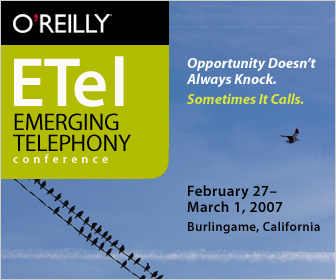
ETel logoAs any of my regular readers have figured out, I love CES, it’s my favorite technology conference (as opposed to CeBIT, which is my least favorite – ugh, Hannover). The next-most enjoyable tech activities to me are the ones where you get to see upcoming stuff that’s either just reaching the market as well as the stuff that may never hit the market (Wired’s NextFest is a great example). So when I heard about O’reilly’s eTel conference here in my own backyard (SF Airport Marriott), I thought it sounded like a good thing to check out.

Here’s the official blurb:

Opportunity Doesn’t Always Knock, Sometimes it Calls. Have you answered the call yet to attend the hottest telephony conference of the year? The Emerging Telephony Conference takes place next week February 27 to March 1, 2007 in Burlingame, California. ETel explores the strategies for taming disruption and exploiting opportunities being created by web telephony innovations.

You can see the list of speakers here and the full schedule is here. I’m not exactly sure if I’ll make it to all the sessions or just 2 of the days, but if anyone wants to geek out at lunch or something, get in touch.

Also, the kind folks at O’Reilly are giving LD readers a special 40% off discount. Not too shabby, eh? Register today with code etel07fnf40.

Posted in Convergence, General | Leave a comment |

Satellite Radio Merger: color me unsurprised

Posted on February 19, 2007 by Jeremy Toeman

They’ve tried before, they’re trying again.  Rumors circulate today that XM and Sirius are planning a merger (Updated to include Mark Evans and Ars Technica.  Updated again: it’s official).  The two companies together would represent about 13 million subscribers (6 million from Sirius, 7.6 million from XM), with a ~$8B market cap ($615/subscriber today), about $2B in debt, and roughly $600M in cash on hand (source: financial stats for SIRI and XMSR).  Interesting, as Echostar has roughly the same subscriber base, more profitability (and more room for profitability), yet only twice the market cap.

Another interesting thought is on room for growth. 13 million subscribers represents roughly 6% of the ~240M cars in use around the US, or 10% of households, depending on which model you think is more successful (I vote car).  So I ponder how much of a real growth opportunity lays ahead?

Apparently Howard Stern believes 30-40M households in the next couple of years. Bridge Ratings predicts 50 million subscribers by 2020.  That’s 1 in 5 drivers paying for satellite service.  This sounds high to me, from industry, professional, and personal experience.  I don’t see enough factors driving consumers into “dissatisfaction” with standard radio, especially when compared to the option of consumer more of their own content via iPods and other players.

Some predict podcasting and integrated car-iPod adapters may kill satellite radio.  That doesn’t really sound right either.  Talk to the average XM or Sirius subcriber, they seem quite satisfied with their service.  I think satellite radio has a “TiVo effect” where the product is quite good, and once in, you are hooked, but until you get there, you scratch your head a lot about paying extra money for something you seem to already have in your life. 

Unfortunately, unlike a DVR, which makes the entire TV experience leaps and bounds better, satellite radio doesn’t have as broad an appeal.  If you don’t commute for long hours, you’re hard to hook.  If you work long hours at a desk and want more variety in radio, odds are good that Internet services have even more appeal (not to mention the fact that if you aren’t near a window, you aren’t getting a satellite signal).

We’re about 5 years into the satellite radio business.  I believe there’s still a little growth ahead, but it’s going to be slow, and may cap out very soon.  I believe the companies benefit from a merger, as it leaves less FUD for a prospective consumer.  I believe it’s an industry doomed once pervasive Internet services become available and consumers get anywhere-access to services such as Rhapsody, Pandora, Last.FM, and their own personal media collections.

Posted in Convergence, General, Mobile Technology | Leave a comment |

Is TV really opening up soon?

Posted on February 10, 2007 by Jeremy Toeman

I’ve worked in the field of digital media and consumer technology for about 8 years now, and for all eight years, I’ve heard people predicting the imminent change and overhaul of the TV industry.  Back in the late nineties, it was the dawn of interactive television.  In the early 2000s, it was the dawn of IPTV, about to be launched by all the telcos everywhere.  For the last couple of years, it’s the end of TV, as it’ll be completely replaced by streaming Internet video and user-generated content (UGC).

Guess what folks, the one hundred and ten million households (that’s 110,000,000) who consume cable and satellite TV are a lot further away from big change than some experts seem to think.  Steve Rubel wrote a piece yesterday which I feel contains exactly the examples of misplaced hype:

The race is on to turn your TV into an open content platform. This will bring more programming to your set and much of it won’t come from the traditional networks. Conspicuously absent from the game are your local cable and satellite providers. Should they fail to act, they all run the risk of turning into commodity services.

…

If you wanted to, you can already ditch your cable or satellite provider. Wired news ran an experiment a few months back showing that it is possible to get a lot of content on your set without them, though there are still lots of caveats. As the big technologies players continue to refine their IPTV strategy, the need for cable TV programming will diminish.

It is most certainly possible to do such a thing, but in an era of increasing HDTV programming (DirecTV is en route to 100 HD channels this year), why on earth would you make such a change?  I watch Heroes pretty religiously.  Now I can stream every episode from NBC.com, which is a great way for people to catch up with the show, but the viewing experience doesn’t even come close to the one I have now. 

Now I suppose I could find an illegal download of the HDTV version, then hook up a PC to my TV set (or buy one of the upcoming “connected home” devices), then watch it that way.  But that’s a major shlep for the masses, and most certainly, in every way, a worse experience than using even a cable-company provided DVR (because $800 for a Series3 is still too much, no matter how great the product is).

We also saw a report circulate recently claiming YouTube users watch less TV.

Frequent YouTube users said they are spending less time visiting other websites (36 percent) less time watching TV (32 percent), less time on email and other online social networking (20 percent), and, well, less time on just about everything else.

I guess I’m just too much of a disbeliever in studies like these, and for one basic reason:  most people tend to say they watch less TV when polled.  It’s as if all of TV watching were merely a guilty pleasure.  Yet, reports show Americans are watching more TV than ever before (whether you like Nielsen or not, it is still considered the de facto standard in TV viewership information).

Now I do believe in an increase of video consumption, and believe that the use of both PC-based TV watching and Internet-enabled TVs are on the rise.  I believe we will see an increased quantity of diverse options as to how we choose to watch TV.  In fact, after all we accomplished at Sling Media, I was surprised to see articles this week with the non-evil-doing Googlers claiming the Internet can’t deliver TV content yet (recommended reading from GigaOm, ZatzNotFunny, and WebTVWire).  Sure it can, it’s just a question of how it should be used.

In my Mac-PC video debate last month, Fred Davis and I diverted to talking about broadcast vs IPTV delivered television, which Josh Catone chimed in on in his blog as well.  I believe the future on this topic is going to be determined primarily from an economic basis.  At present, we have the infrastructure in place where, if desired, every single household in the US can watch the same TV show live in real-time.  Broadcasting of content requires no new infrastructure build-out (unless, of course, we want a lot more HD stuff, which, of course, we do).  Doing the same thing over IP networks wouldn’t work, and wouldn’t even come close.

So why bother trying to make it work?  It simply doesn’t make sense to build out a massive IP infrastructure to do it.  However, let’s say that at any given time, all 110MM households want to watch a “recent episode” of a show (say, last week’s Heroes).  Best method possible?  Give them all DVRs, use the broadcast pipe to get it to the house, let them watch it time-shifted however they’d like. 

But now let’s say that all 110MM households want to watch radically different content, such as the episode of The Facts of Life where Blair learns a very important lesson, or that very special Blossom.  Then, having access to a personalized, on-demand IP network is ideal.  It’s costly to build, costly to maintain, and time-consuming to construct (not to mention dealing with the graphical user interface complexities), but it’s the right model.

Ultimately, I do believe in a future wherein a hybrid of services are available.  But it’s the future, and not the present, and there is a lot less of a rush to make it happen than we in the technology community might like.  Cable companies have increased billing rates higher than inflation for almost 10 consecutive years (since good old, helpful to consumers deregulation – that’s sarcasm people).  The costs to get an IP service off the ground are staggering (ask the people at companies like Akimbo for validation).

So I’ll end by making my conservative prediction:  the majority of US households will continue to consume television the way they do today for no less than 5 years, and even then the changes will be gradual and evolutionary, not drastic and revolutionary.

Posted in Convergence, General, Video/Music/Media | 3 Comments |
« Previous Page
Next Page »

About

Jeremy Toeman is a seasoned Product leader with over 20 years experience in the convergence of digital media, mobile entertainment, social entertainment, smart TV and consumer technology. Prior ventures and projects include CNET, Viggle/Dijit/Nextguide, Sling Media, VUDU, Clicker, DivX, Rovi, Mediabolic, Boxee, and many other consumer technology companies. This blog represents his personal opinion and outlook on things.

Recent Posts

  • Back on the wagon/horse?
  • 11 Tips for Startups Pitching Big Companies
  • CES 2016: A New Role
  • Everything I Learned (So Far) Working For a Huge Company
  • And I’m Back…

Archives

Pages

  • About

Archives

  • January 2019
  • April 2016
  • January 2016
  • December 2015
  • June 2015
  • May 2015
  • April 2015
  • March 2015
  • February 2015
  • January 2015
  • December 2014
  • November 2014
  • October 2014
  • September 2014
  • August 2014
  • June 2014
  • May 2014
  • April 2014
  • March 2014
  • January 2014
  • December 2013
  • September 2013
  • August 2013
  • July 2013
  • May 2013
  • February 2013
  • January 2013
  • December 2012
  • October 2012
  • September 2012
  • August 2012
  • May 2012
  • April 2012
  • March 2012
  • February 2012
  • January 2012
  • December 2011
  • November 2011
  • October 2011
  • September 2011
  • August 2011
  • June 2011
  • March 2011
  • February 2011
  • January 2011
  • December 2010
  • November 2010
  • October 2010
  • September 2010
  • August 2010
  • July 2010
  • June 2010
  • May 2010
  • April 2010
  • March 2010
  • February 2010
  • January 2010
  • December 2009
  • October 2009
  • September 2009
  • August 2009
  • July 2009
  • June 2009
  • May 2009
  • April 2009
  • March 2009
  • February 2009
  • January 2009
  • December 2008
  • November 2008
  • October 2008
  • September 2008
  • August 2008
  • July 2008
  • June 2008
  • May 2008
  • April 2008
  • March 2008
  • February 2008
  • January 2008
  • December 2007
  • November 2007
  • October 2007
  • September 2007
  • August 2007
  • July 2007
  • June 2007
  • May 2007
  • April 2007
  • March 2007
  • February 2007
  • January 2007
  • December 2006
  • November 2006
  • October 2006
  • September 2006
  • August 2006
  • July 2006
  • June 2006
  • May 2006
  • April 2006
  • March 2006
  • February 2006
  • January 2006
  • December 2005
  • November 2005
  • October 2005
  • September 2005
  • August 2005
  • July 2005
  • June 2005
  • May 2005
  • April 2005
  • March 2005
  • February 2005
  • January 2005
  • December 2004
  • November 2004
  • October 2004
  • September 2004

Categories

  • Convergence (81)
  • Gadgets (144)
  • Gaming (19)
  • General (999)
  • Guides (35)
  • LD Approved (72)
  • Marketing (23)
  • Mobile Technology (111)
  • Networking (22)
  • No/Low-tech (64)
  • Product Announcements (85)
  • Product Reviews (109)
  • That's Janky (93)
  • Travel (29)
  • Video/Music/Media (115)
  • Web/Internet (103)

WordPress

  • Log in
  • WordPress

CyberChimps WordPress Themes

© LIVEdigitally